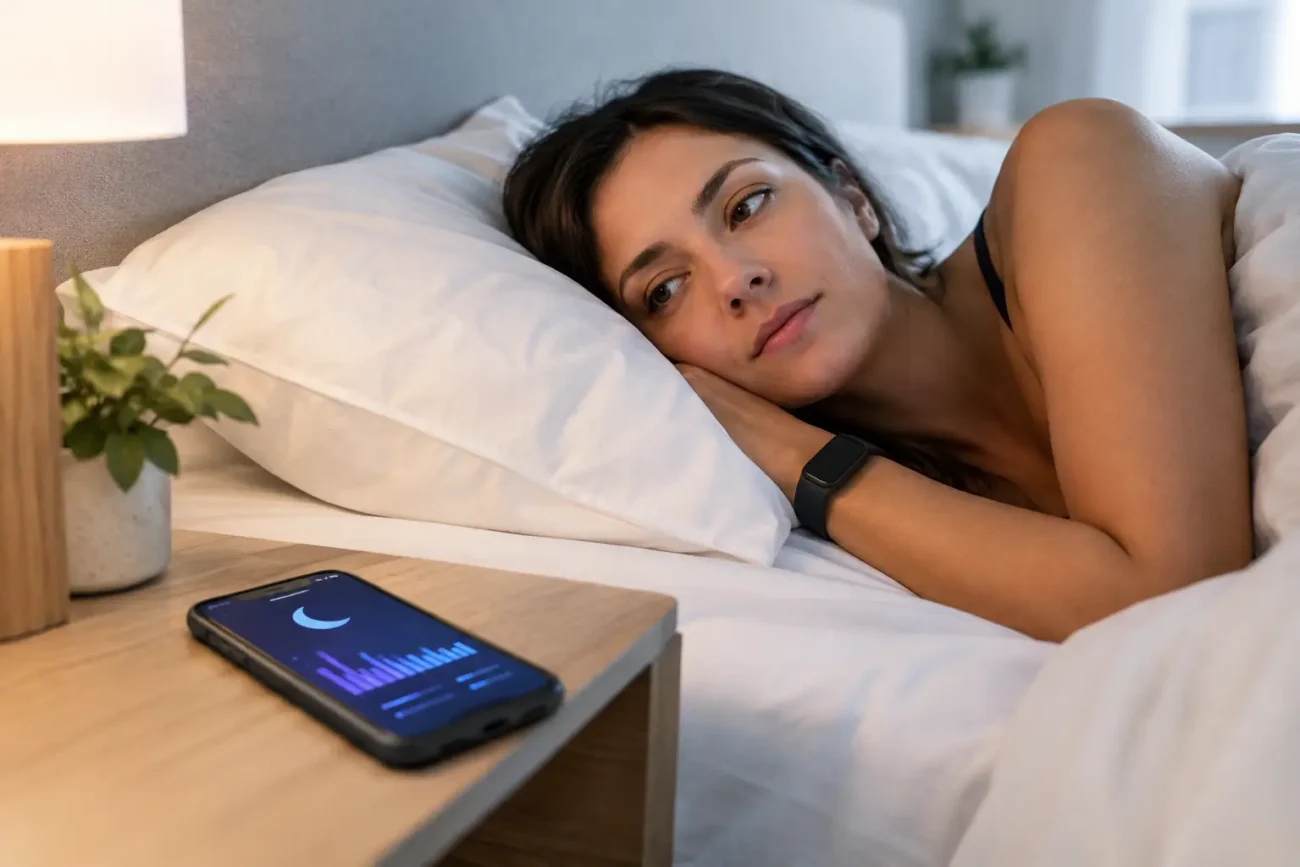
You wake up feeling as though you barely slept, then your watch says you logged seven hours and a respectable sleep score. Or the reverse happens: you feel fine, but your device reports a disappointing night of deep sleep. Sleep trackers can be helpful, but only if you understand what the data can – and cannot – tell you.
For many people in midlife, sleep becomes less predictable. Menopause, changing work schedules, medications, pain, alcohol, stress, and common conditions such as sleep apnea can all alter the night. A tracker may make patterns easier to spot. It cannot diagnose the reason for those patterns, and it should never overrule how you actually feel.
What Sleep Trackers Actually Measure
Most consumer sleep trackers are watches, rings, mattress sensors, or phone-based apps. Wearable devices usually combine movement data with heart rate and heart rate variability, which is the small variation in time between heartbeats. Some also estimate breathing rate, skin temperature, or blood oxygen levels.
From those signals, the device uses an algorithm to estimate when you were awake, in light sleep, deep sleep, and REM sleep. REM sleep is the stage associated with vivid dreaming and some aspects of memory and emotional processing. Deep sleep is more common earlier in the night and is generally associated with physical restoration.
The key word is estimate. In a sleep laboratory, clinicians measure brain waves, eye movements, muscle activity, breathing, oxygen levels, and more. That test, called polysomnography, can identify sleep stages with far greater precision. A wrist device does not measure brain activity. It makes an educated calculation from indirect clues.
That calculation is often reasonably good at identifying total sleep time for some people, especially on an ordinary night. It is much less reliable at separating quiet wakefulness from sleep or assigning exact minutes to individual sleep stages. If you lie still in bed reading or worrying, a tracker may assume you are asleep. If you toss and turn during light sleep, it may count some of that time as wakefulness.
Which Sleep Tracker Numbers Are Worth Watching?
The most useful information is usually found in trends, not a single morning score. If your total sleep time drops for several weeks, or your resting heart rate is consistently higher after late dinners, evening drinks, or a stressful period, that observation may be worth acting on.
Sleep timing can also be revealing. Many adults discover they are spending plenty of time in bed but sleeping much less than they thought. Others notice a large difference between weekday and weekend schedules. Regularity matters because the body clock responds well to a reasonably consistent wake time, even when bedtime varies slightly.
Pay attention to a few straightforward measures:
- Typical sleep duration: Look at averages over one or two weeks rather than trying to perfect every night.
- Sleep schedule consistency: Notice whether your bedtime and wake time shift dramatically across the week.
- Awakenings and awake time: Treat these as clues, especially if they match your memory of being awake.
- Changes in resting heart rate: A persistent rise can reflect many things, including illness, alcohol, stress, hard training, or poor recovery. It is not specific to sleep.
Sleep-stage charts are often the most tempting and the least actionable part of the report. A lower-than-usual “deep sleep” percentage does not necessarily mean your body failed to recover. Sleep stages naturally vary from night to night, and consumer devices can misclassify them. Instead of chasing a particular amount of deep or REM sleep, ask a more useful question: Do I generally wake rested enough to function well, and has something changed?
When Tracking Can Genuinely Help
A tracker can turn a vague concern into a concrete pattern. Perhaps you suspected that one glass of wine at dinner was harmless, but your data and your morning energy both show more restless nights afterward. Perhaps you find that a late workout does not affect you at all, while scrolling on your phone in bed pushes bedtime later than intended. Those are personal experiments, not universal rules.
Tracking can be especially useful during transitions. People navigating perimenopause or menopause may notice more nighttime awakenings or a change in sleep regularity. Someone adjusting a new medication, recovering from an illness, or beginning an exercise routine can use a tracker alongside a simple note about symptoms and habits.
The strongest approach is to pair the device with context. For two weeks, jot down a few details: caffeine after lunch, alcohol, exercise, unusual stress, nighttime hot flashes, pain, and how alert you felt the next day. You do not need a complicated spreadsheet. A few words in a notebook can reveal more than another decimal point in an app.
The Risk of Becoming Too Focused on the Score
For some people, sleep tracking creates a new source of pressure. They check the score before noticing how they feel, worry about every variation in REM sleep, or stay in bed trying to force better data. Sleep researchers sometimes call this pattern orthosomnia – an unhealthy preoccupation with achieving “perfect” sleep metrics.
That pressure can become self-defeating. Sleep is not a performance test. A stressful workday, a warm bedroom, a later-than-usual meal, or no obvious reason at all can produce a less-than-ideal graph. One uneven night is normal, and even a few rough nights can happen without signaling a serious problem.
Consider taking a break from tracking if the data makes you anxious, causes you to second-guess decent sleep, or encourages rigid rules that interfere with your life. You might wear the device but hide the sleep score for a week, review weekly trends instead of daily results, or stop using the sleep feature altogether. The right tool should support your wellbeing, not make bedtime feel like a test you can fail.
When a Tracker Should Prompt a Medical Conversation
A consumer device is not a diagnostic medical device, but certain patterns deserve attention when they occur alongside symptoms. Speak with a health professional if you snore loudly, gasp or choke in sleep, have witnessed pauses in breathing, wake with headaches, or feel excessively sleepy during the day. These can be signs of sleep apnea, which becomes more common with age and is treatable.
Also bring up ongoing insomnia, frequent waking that lasts for months, uncomfortable urges to move your legs at night, or fatigue that persists despite enough opportunity for sleep. If a device repeatedly flags low oxygen readings, do not panic over one measurement. Fit, movement, cold hands, and sensor limitations can affect results. But do discuss repeated readings with a clinician, particularly if you also have breathing symptoms or heart or lung disease.
A useful appointment starts with your experience: when the problem began, what your nights feel like, and how daytime fatigue affects you. Your tracker data can add context, but it should not be the centerpiece. A clinician may recommend a sleep diary, review medications, check for medical contributors, or arrange formal sleep testing when appropriate.
A Better Way to Use Sleep Data
Use your tracker as a mirror, not a judge. Choose one question you want it to help answer, such as whether a consistent wake time improves your energy or whether late alcohol affects awakenings. Keep the experiment modest, change one habit at a time, and give it at least a week or two before drawing conclusions.
Then return to the measures that matter most: your energy, mood, concentration, safety while driving, and ability to enjoy your day. The best sleep tracker is not the one with the busiest dashboard. It is the one that helps you notice a useful pattern – and then lets you put the device aside and get on with living.
